

A roof problem rarely stays on the roof. A leak can interrupt a working day, damage stored products, or leave tenants asking when repairs will be finished. When a Denver commercial property needs roofing work, the real decision is how to protect the building while making maintenance and future expenses manageable.
Spray polyurethane foam, or SPF, and traditional roofing systems approach that job differently. Foam is formed on the roof during application. Other options use manufactured membranes, reinforced sheets, or metal panels. Each can be worth considering, depending on what your property needs and what the existing roof assessment reveals.
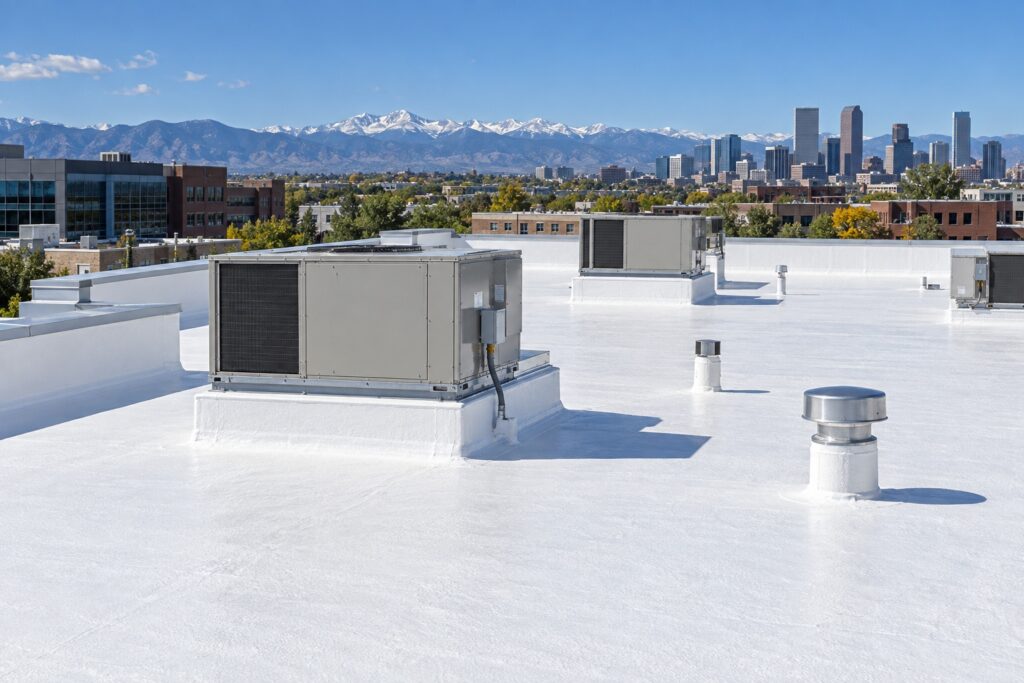
Which suits your building?
Start with its condition, use, and roof design. Spray foam may offer a useful combination of insulation and restoration on suitable surfaces. A traditional system may better match a replacement project or a specific construction requirement. The strongest choice is the one supported by a clear plan for your property.
What Is Spray Foam Roofing?
SPF roofing uses spray-applied polyurethane foam that expands and adheres to a prepared surface. Roofing-grade foam is rigid, closed-cell material; it should not be confused with open-cell foam used in some interior insulation applications.
The installation includes a protective covering, often an elastomeric coating. Foam and coating perform different jobs: the foam supplies insulation and forms a continuous layer, while the covering protects it against sunlight and weathering. Surface preparation, specified thickness, and trained application are essential.
A coating-only restoration is different from installing a new SPF system. When reviewing estimates, ask whether the proposal includes new foam insulation, restoration of existing foam, or a coating over another roof material.
What Counts as Traditional Commercial Roofing?
“Traditional roofing” describes several systems rather than one product:
- TPO: A thermoplastic single-ply membrane with heat-welded seams, commonly available in reflective colors.
- EPDM: A synthetic rubber membrane, frequently black, with seams joined using compatible system materials.
- Modified bitumen: Reinforced asphalt sheets installed as a layered roof system.
- Metal: Roofing panels with engineered seams, attachments, and flashing details.
These systems should be compared as complete assemblies. A membrane roof can include substantial insulation beneath its surface. Metal roofs also vary widely in their construction and insulation. Comparing bare membrane thickness with foam thickness would give an incomplete picture.
Spray Foam vs. Traditional Roofing: Quick Comparison
| Consideration | Spray foam roofing | Traditional roofing systems |
| Insulation | Foam contributes insulation directly | Insulation typically comes from other assembly components |
| Surface details | Adapts around suitable shapes and penetrations | Uses system-specific sheets, panels, and flashings |
| Existing roof | May suit a compatible, dry, sound substrate | Recovery or replacement depends on the system and roof condition |
| Maintenance | Inspect protective coating and renew as needed | Inspect seams, flashings, attachments, and surface condition |
| Installation | Sensitive to application weather and surface conditions | Requirements vary by membrane, adhesive, and attachment method |
| Best starting point | Assess restoration and insulation potential | Assess assembly requirements and replacement options |
Which System Makes Sense in Denver’s Climate?
Sun Exposure and Seasonal Temperatures
SPF must remain protected from ultraviolet exposure. A damaged or worn coating can expose the foam and allow deterioration, making coating maintenance part of ownership.
Reflective surfaces are available on both foam and membrane roofs. However, a white surface alone does not establish which option will produce the lowest annual energy bill. Ask for a comparison that considers insulation, heating and cooling demand, indoor use, and the existing roof assembly.
For example, an air-conditioned office and a minimally heated storage building may have very different priorities even when their roof areas are similar.
Hail, Wind, and Snow
Avoid choosing a roof based on an unsupported “hail-proof” claim. Ask about the proposed assembly’s tested performance, the protective surface, and how storm damage would be inspected and repaired.
Wind resistance also depends on attachment, adhesion, perimeter details, and the underlying deck. For snow, drainage and structural capacity deserve attention alongside the roof covering. A new surface should never be presented as a substitute for evaluating structural concerns.
The useful question is: How will this specific assembly address the exposures and conditions at my building?
Energy Performance: Compare the Whole Assembly
SPF’s insulation is a practical reason to investigate it, particularly during restoration planning. But the comparison should use the proposed finished assembly, not broad claims that one material always saves more energy.
Request the specified insulation thickness and thermal performance for each option. Also ask how penetrations, transitions, existing insulation, and moisture conditions are addressed. An estimate that simply says “energy-efficient roof” offers little basis for comparison.
For a Denver office, comfort complaints may justify examining the roof alongside HVAC performance. For a warehouse, operating hours and conditioned space may change the calculation. Treat promised savings as something to substantiate with building-specific analysis.
Can Spray Foam Be Applied Over an Existing Roof?
Sometimes. Suitability depends on the existing material, moisture, adhesion, roof condition, and project requirements. The decision should follow a hands-on assessment of your building rather than an assumption that every existing roof can be covered.
A contractor should investigate leaks before recommending an overlay. Ask how wet areas will be identified, which materials require removal, and how the prepared surface will be accepted before installation.
This is especially relevant when comparing a restoration proposal with a complete replacement. The lower-priced proposal may cover a different scope. Make sure both estimates explain what happens to damaged decking, saturated insulation, deteriorated flashings, and drainage problems.
Flat, Low-Slope, and Barrel Roof Considerations
On flat and low-slope commercial roofs, pay close attention to drains, ponding areas, equipment curbs, and wall transitions. “Flat” should not mean ignoring drainage.
Barrel roofs introduce curved geometry. Spray-applied material can accommodate suitable curved surfaces, but that does not make every barrel roof a candidate. The contractor must assess substrate compatibility, preparation, attachment or adhesion, and how water will leave the roof.
Ask for details that match your building’s actual shape. A proposal prepared for a straightforward rectangular roof may overlook the transitions that make your project more demanding.
Installation, Maintenance, and Long-Term Cost
Plan Around Business Operations
Discuss roof access, parking, delivery routes, rooftop equipment, and work sequencing before installation begins. For spray applications, ask how nearby vehicles, neighboring properties, and building air intakes will be protected. Occupancy precautions should follow the products and site conditions.
For other systems, ask about removal debris, material staging, adhesives, and weather protection during construction. Every proposal should explain how the building will remain protected between workdays.
Budget for Care, Not Just Installation
Set up a maintenance plan when the roof is installed, with inspection timing tailored to its condition, exposure, and product requirements. After a significant storm, arrange a professional review if damage is suspected. The protective surface needs attention throughout the roof’s service life.
Traditional roofs also need planned inspection and repairs. Request a written maintenance schedule for whichever assembly you select, including responsibility for checking drainage and areas around serviced equipment.
Compare installation, repairs, scheduled maintenance, future restoration, and eventual replacement over the same ownership period. Read warranty exclusions carefully, and clarify whether coverage includes materials, workmanship, or both. Warranty length alone should not decide the purchase.
Make the Decision Around Your Building
Imagine two Denver properties: an occupied office with a roof suitable for restoration, and an older warehouse with extensive underlying damage. Their owners may receive very different recommendations. The office owner might explore foam as part of an insulation and restoration project. The warehouse owner may need removal and replacement before choosing a new surface. These hypothetical examples show why roof condition should lead the conversation.
Before selecting a Denver commercial roofing contractor, request photographs of existing conditions, a written scope, product specifications, and an explanation of why the proposed system fits. Ask each bidder to address the same problems so you can compare meaningful alternatives.
Frequently Asked Questions
Is spray foam better than TPO for Denver buildings?
Neither is universally better. SPF may suit restoration and complex surface details, while TPO may suit a specified single-ply assembly. Compare roof condition, insulation, installation requirements, and maintenance plans.
Does foam roofing need a protective coating?
It needs an approved protective covering. Without suitable protection, UV exposure can damage the foam. Follow the specified system’s inspection and renewal requirements.
Will a new foam roof stop every leak?
No system can guarantee that. Successful work requires identifying leak sources and addressing drainage, flashings, penetrations, and underlying damage rather than simply covering the surface.
Is spray foam always cheaper than replacement?
No. Costs depend on preparation, removal, access, insulation, detailing, and material specifications. Compare written estimates with equivalent scopes before deciding which offers better value.
Can a foam roof be recoated?
Yes, when its condition supports restoration. Inspection should establish necessary repairs and coating compatibility before recoating. The schedule depends on the installed system and its condition.
Protect Your Denver Property with Colorado Weather Coatings
Protect Your Building. Plan for Performance. Invest with Confidence.
Exploring spray foam roofing or commercial roof restoration in Denver, Colorado? Contact Colorado Weather Coatings to discuss your building’s condition, insulation needs, and roofing goals.
Whether you manage a flat, low-slope, or barrel-roof building, start with a conversation about the system that fits your property and maintenance budget.
Contact Colorado Weather Coatings today to discuss your commercial roofing project.