

Commercial roofs in Colorado have a demanding job. Intense sunshine, UV exposure, hailstorms, snow, wind, and frequent temperature changes can put roofing materials under considerable stress. For building owners and facility managers, choosing the right commercial roofing system is therefore about more than stopping leaks—it is also about insulation, energy efficiency, durability, maintenance, and long-term cost.
One option worth considering is spray foam roofing, also known as spray polyurethane foam (SPF) roofing.
Quick Answer: Is Spray Foam Roofing Good for Colorado Commercial Buildings?
Yes, spray foam roofing can be an excellent choice for many commercial buildings in Colorado, particularly flat and low-slope roofs.
SPF creates a seamless, fully adhered roofing layer that combines waterproofing and insulation. When properly installed and protected with a suitable elastomeric coating, it can help commercial properties deal with Colorado’s strong sunshine, temperature changes, precipitation, and demanding seasonal conditions.
It isn’t automatically the right roof for every property, however. The existing roof condition, drainage, building use, installation conditions, hail exposure, and maintenance requirements should all be evaluated before choosing SPF.
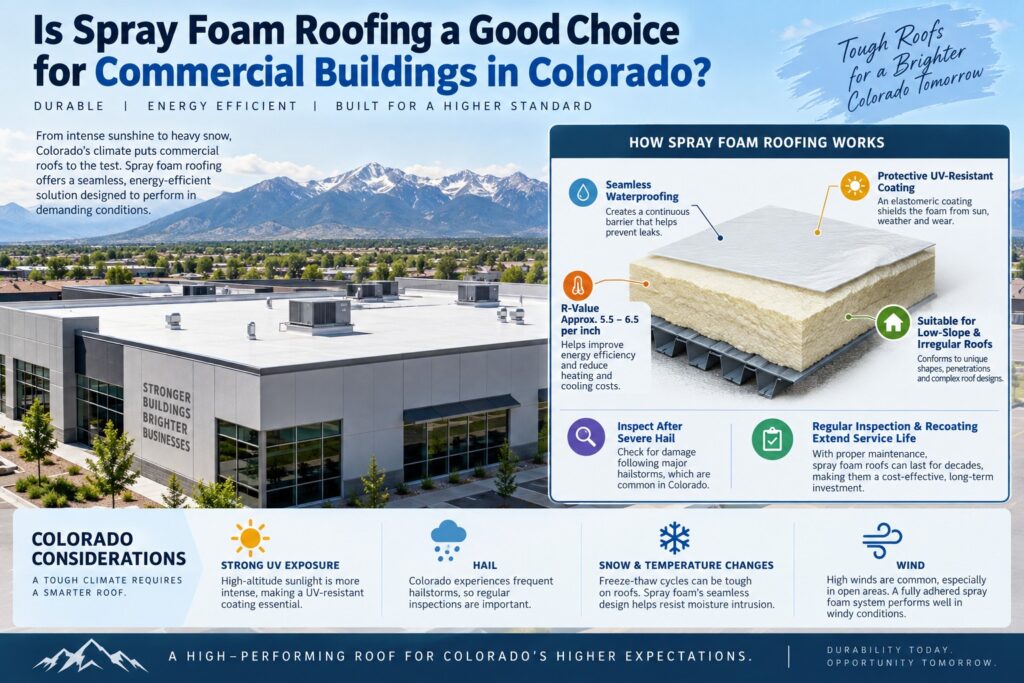
What Is Spray Foam Roofing?
Spray polyurethane foam roofing is created by combining liquid components that react when sprayed onto a prepared roof surface. The material expands and hardens, creating a continuous layer of rigid, closed-cell foam.
Unlike roofing systems assembled primarily from sheets or rolls, SPF is applied directly to the roof and conforms to its shape.
The foam performs two important functions:
- It creates a continuous waterproofing layer.
- It provides thermal insulation.
SPF is then covered with a protective coating, such as silicone, acrylic, polyurethane, or another compatible roof coating. This top layer is particularly important because polyurethane foam needs protection from ultraviolet radiation and normal weather exposure.
According to industry guidance, roofing SPF typically provides approximately R-5.5 to R-6.5 per inch, although actual performance varies by product and system.
That combination of insulation and waterproofing is one of the main reasons SPF is attractive for commercial roofing projects.
Why Consider Spray Foam Roofing in Colorado?
Colorado creates several challenges for commercial roofs.
Depending on the location, a roof may experience strong sunlight, hail, snow, freeze-thaw conditions, wind, and substantial temperature changes throughout the year.
A successful roofing system therefore needs to address more than rain.
1. Seamless Protection Against Water
One of the biggest advantages of spray foam roofing is its seamless construction.
Traditional membrane roofs contain seams, joints, penetrations, and flashing details that must remain watertight. SPF is sprayed continuously across the roof and around many penetrations and irregular details.
This creates a monolithic roofing surface.
Fewer seams can mean fewer obvious pathways for moisture intrusion when the system is correctly installed and maintained.
This can be especially useful on commercial buildings containing multiple HVAC units, vents, pipes, drains, skylights, and other rooftop equipment.
2. Excellent Insulation Performance
Heating and cooling commercial buildings can represent a significant operating expense.
Colorado businesses must often deal with both hot summer conditions and cold winter temperatures. A poorly insulated roof can allow unwanted heat transfer in both directions.
SPF addresses this by adding continuous insulation directly to the roof.
Industry sources place roofing SPF around R-5.5 to R-6.5 per inch, while specific closed-cell SPF products may fall around R-5.8 to R-6.9 per inch.
Continuous insulation can also reduce some of the thermal bridging associated with seams and mechanical fasteners.
For building owners researching energy-efficient commercial roofing in Colorado, this is one of SPF’s most attractive characteristics.
3. Well Suited to Flat and Low-Slope Commercial Roofs
Warehouses, offices, retail buildings, manufacturing facilities, schools, and many other commercial properties use flat or low-slope roofing systems.
These roofs can develop drainage problems if water collects in low areas.
SPF provides an interesting advantage: installers can vary the foam thickness to help create or improve slope toward drainage locations.
Industry guidance identifies low-slope roofs as suitable platforms for SPF systems while emphasizing that excessive ponding water should still be avoided.
This doesn’t mean spray foam can correct every drainage or structural problem. Existing drainage issues should be identified during the roof assessment.
4. SPF Works Well Around Complicated Roof Details
Commercial rooftops are rarely completely empty.
They can include:
- HVAC equipment
- Pipes
- Vents
- Skylights
- Exhaust systems
- Drains
- Curbs
- Ductwork
- Unusual roof transitions
Because SPF is spray-applied, it conforms to many irregular shapes and can create continuous protection around complicated roof details.
This adaptability can make spray foam particularly useful when retrofitting older commercial buildings with complicated roof layouts.
5. Lightweight Roofing Solution
Adding another roofing system to an existing commercial building raises an important question: How much additional weight will the roof structure need to support?
SPF is relatively lightweight.
The Spray Polyurethane Foam Alliance notes that SPF roofing’s installed weight per square foot can provide building owners and designers with options that may not be available with heavier roofing assemblies.
However, this does not eliminate the need for a professional roof assessment. The condition and structural capacity of the existing roof deck must still be considered.
How Does Spray Foam Roofing Handle Colorado Hail?
This is an especially important question for Colorado property owners.
SPF roofing, like other roofing materials, can sustain hail damage.
The severity depends on factors such as hailstone size, protective coating, system design, foam properties, and impact intensity. Industry guidance notes that hail can create dents and potentially compromise the protective coating.
The positive side is repairability.
Localized SPF damage can often be repaired without replacing an entire commercial roof. The damaged area can be evaluated, repaired, sealed, and recoated as appropriate.
Building owners should also discuss the system’s specific impact or hail rating with their roofing contractor rather than assuming every SPF assembly offers identical hail resistance.
After a significant Colorado hailstorm, arranging a roof inspection is a sensible maintenance practice.
What About Colorado’s Strong Sun and UV Exposure?
The protective coating becomes extremely important here.
Bare polyurethane foam should not remain exposed to sunlight because UV radiation will degrade its surface over time. A properly installed SPF roofing system therefore includes a compatible protective coating.
Depending on the system, coatings may also provide additional impact, abrasion, weather, and moisture resistance.
Reflective roof coatings can further help reduce solar heat absorption, making the complete SPF-and-coating system particularly relevant to Colorado’s sunny climate.
The key point is simple:
SPF and its protective coating should be viewed as one complete roofing system—not as separate optional components.
Can Spray Foam Roofing Help Reduce Commercial Energy Costs?
Potentially, yes.
SPF provides continuous insulation across the roof surface, helping limit heat transfer between the building and exterior environment.
During Colorado winters, that insulation can help reduce heat loss through the roof. During warmer periods, it can help reduce heat entering the building.
When combined with an appropriate reflective roof coating, SPF can contribute to a more energy-efficient building envelope.
Actual savings will vary considerably depending on the building’s existing insulation, HVAC efficiency, roof area, energy use, foam thickness, occupancy, and local weather.
Therefore, property owners should avoid generic promises about a specific percentage of energy savings.
A building-specific energy or roof assessment provides a more reliable estimate.
Can Spray Foam Be Installed Over an Existing Commercial Roof?
In many cases, SPF may be installed over a suitable existing roofing substrate after proper inspection and preparation.
This can potentially reduce the amount of roof material that needs to be removed.
But not every existing roof should simply be covered.
Before installation, contractors should determine whether there is:
- Trapped moisture
- Saturated insulation
- Structural damage
- Poor adhesion
- Contamination
- Serious drainage problems
- Deteriorated roofing materials
Wet or unsuitable materials may need to be removed or repaired before SPF installation.
Proper surface preparation is critical to adhesion and long-term performance. SPFA installation guidance emphasizes evaluation and preparation of the roof deck before applying the foam and protective covering.
Are There Disadvantages to Spray Foam Roofing?
Yes. Like every commercial roofing system, SPF has limitations.
Installation Is Highly Specialized
SPF roofing is not a simple coating application.
Material temperatures, equipment settings, substrate condition, weather, moisture, wind, spray technique, foam thickness, and coating application can influence the finished roof.
The quality of the installer therefore matters enormously.
Weather Can Affect Installation
Spray foam must be installed under appropriate environmental conditions.
Wet substrates, excessive wind, unsuitable temperatures, or approaching precipitation can interfere with installation quality.
Colorado’s rapidly changing weather makes planning and experienced installation particularly important.
The Protective Coating Requires Maintenance
The coating above the SPF does not last forever.
Regular inspection and eventual recoating are part of responsible SPF roof ownership. SPFA guidance recommends periodic inspections and inspections following severe weather events.
Rather than viewing recoating as a disadvantage alone, commercial property owners should consider it part of the roof’s lifecycle strategy.
How Long Can a Spray Foam Commercial Roof Last?
A properly designed, installed, inspected, repaired, and recoated SPF roof can have a long service life.
Industry guidance describes service lives exceeding 20 years with regular maintenance, with continued inspection and recoating potentially extending service for decades.
Actual roof life depends on installation quality, foam and coating specifications, weather exposure, rooftop traffic, maintenance, storm damage, and how quickly repairs are completed.
This renewability is one of SPF’s biggest advantages.
Instead of automatically replacing the entire roof when the protective coating reaches the end of its service life, a suitable SPF system may be cleaned, repaired where necessary, and recoated.
What Commercial Buildings Are Good Candidates for SPF Roofing?
Spray foam roofing may be particularly worth evaluating for:
- Warehouses
- Industrial buildings
- Retail properties
- Office buildings
- Manufacturing facilities
- Schools
- Commercial facilities with numerous roof penetrations
- Flat and low-slope commercial roofs
- Older roofs needing improved insulation
- Buildings seeking a lightweight roof restoration option
The best way to determine suitability is through an on-site commercial roof assessment.
Spray Foam Roofing vs. Traditional Commercial Roofing
There is no universally “best” commercial roofing material.
TPO, EPDM, PVC, modified bitumen, metal roofing, roof coatings, and SPF all have appropriate applications.
SPF’s distinctive advantage is that it combines several functions into one system:
Insulation + seamless waterproofing + slope-building capability + protective coating.
That makes it especially attractive when energy performance, complicated roof geometry, and roof restoration are priorities.
Conversely, a different roofing system may make more sense if the existing roof has extensive structural damage or if project conditions make proper spray application impractical.
Is Spray Foam Roofing Worth It for Colorado Businesses?
For many commercial properties, it can be.
Colorado businesses need roofing systems capable of dealing with strong sunlight, seasonal temperature changes, snow, rain, hail, and wind.
SPF offers several characteristics that align well with those demands:
Seamless protection, continuous insulation, lightweight construction, adaptability around penetrations, repairability, and the ability to renew the protective surface through recoating.
However, the biggest determining factors are installation quality and ongoing maintenance.
A high-quality SPF system installed by experienced professionals and maintained correctly is very different from poorly applied foam installed under unsuitable conditions.
Frequently Asked Questions About Spray Foam Roofing in Colorado
Is spray foam roofing waterproof?
Closed-cell SPF forms a seamless, fully adhered roofing layer and is used as part of a waterproof roofing system. The foam is protected by an appropriate elastomeric coating or other approved covering.
Is spray foam roofing suitable for Colorado winters?
It can be. SPF provides continuous insulation and can be used in demanding climates. The complete roofing assembly must be properly designed for the building, local climate, drainage, and applicable code requirements.
Can hail damage a spray foam roof?
Yes. Severe hail can dent SPF and damage its protective coating. Damage is often localized and repairable, but the roof should be inspected following significant hailstorms.
How often should a spray foam roof be inspected?
Regular professional inspections are recommended, along with additional inspections following severe weather. SPFA’s roofing guidance recommends biannual inspections as a best practice.
Does spray foam roofing need to be recoated?
Yes. The coating protects SPF from UV exposure and weathering. Recoating intervals vary depending on the coating system, thickness, climate, exposure, and roof condition.
Can SPF improve commercial building energy efficiency?
Yes, SPF’s high R-value per inch and continuous insulation can reduce heat transfer through the roof. Actual energy savings vary by property.
Can spray foam roofing be installed over an old roof?
Often it can, provided the existing roof and substrate are suitable. A professional inspection should identify wet insulation, damaged materials, structural issues, or other conditions that require correction first.
Is spray foam roofing good for flat commercial roofs?
Yes. Low-slope commercial roofs are common applications for SPF, and foam thickness can be adjusted to help improve drainage in appropriate situations.
Final Verdict: Is SPF Roofing Right for Your Colorado Commercial Property?
Spray foam roofing can be a very good choice for commercial buildings in Colorado when the property, existing roof, and installation conditions are suitable.
Its seamless construction helps control water intrusion, while its continuous insulation can improve thermal performance. Its lightweight and highly adaptable nature also makes SPF useful for complicated commercial roofs and restoration projects.
Colorado’s climate does mean that protective coatings, hail inspections, drainage, and routine maintenance cannot be ignored.
Before making a decision, have the existing commercial roof professionally inspected and compare SPF with other appropriate roofing systems based on lifecycle cost, insulation needs, roof condition, drainage, hail exposure, maintenance requirements, and expected service life.
The right question isn’t simply, “Is spray foam roofing good?”
It’s:
Is spray foam roofing the right system for this Colorado commercial building?
For many properties, the answer may be yes.